13.08.2026
Fluoscore
Oncology
Liver + 2 Cancer types
DMPK Tox
Irinotecan: Liver-dependent efficacy on colon carcinoma, hepatotoxicity, and selectivity (colon cancer vs breast cancer)
About the drug
Irinotecan is an anticancer drug mainly used as a first-line therapy for colorectal cancer. Irinotecan has a second therapeutic indication which is the small cell lung carcinoma, but it is less active on other types of cancer. It is activated by the liver and by plasmatic enzymes into SN-38, the active metabolite of Irinotecan. Then, SN-38 is transported to colon carcinoma cells to exert its antineoplasic activity.
Experimental design
To assess simultaneously the liver-dependent efficacy of Irinotecan and its selectivity, we designed a 3-tissue co-culture system consisting of encapsulated liver spheroids (HepaRG), colon carcinoma spheroids (HCT-116), and breast adenocarcinoma spheroids (MCF-7), treated with increasing doses of Irinotecan for 48h. A staining with AnnexinV-FITC was performed to quantify the induction of apoptosis (cytotoxicity) of Irinotecan.
The colors of the capsules were used to independently and simultaneously measured the effect of Irinotecan in the three tissue types. A mono-culture of each type of tissue and a co-culture without the liver tissue were made in parallel to evaluate the activation of Irinotecan by the liver.
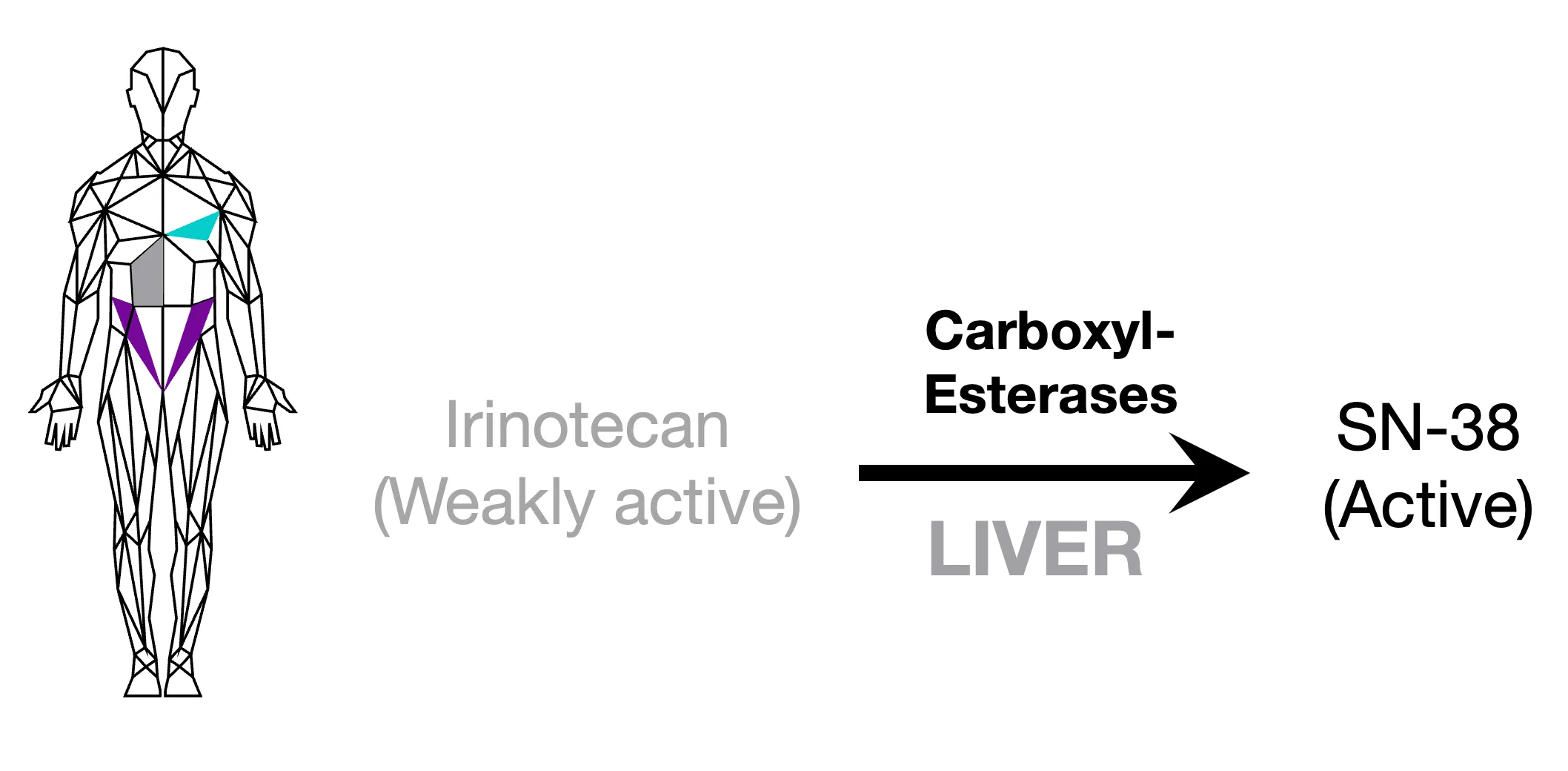
Metabolization of Irinotecan by the liver with the enzymes involved and the active metabolite.
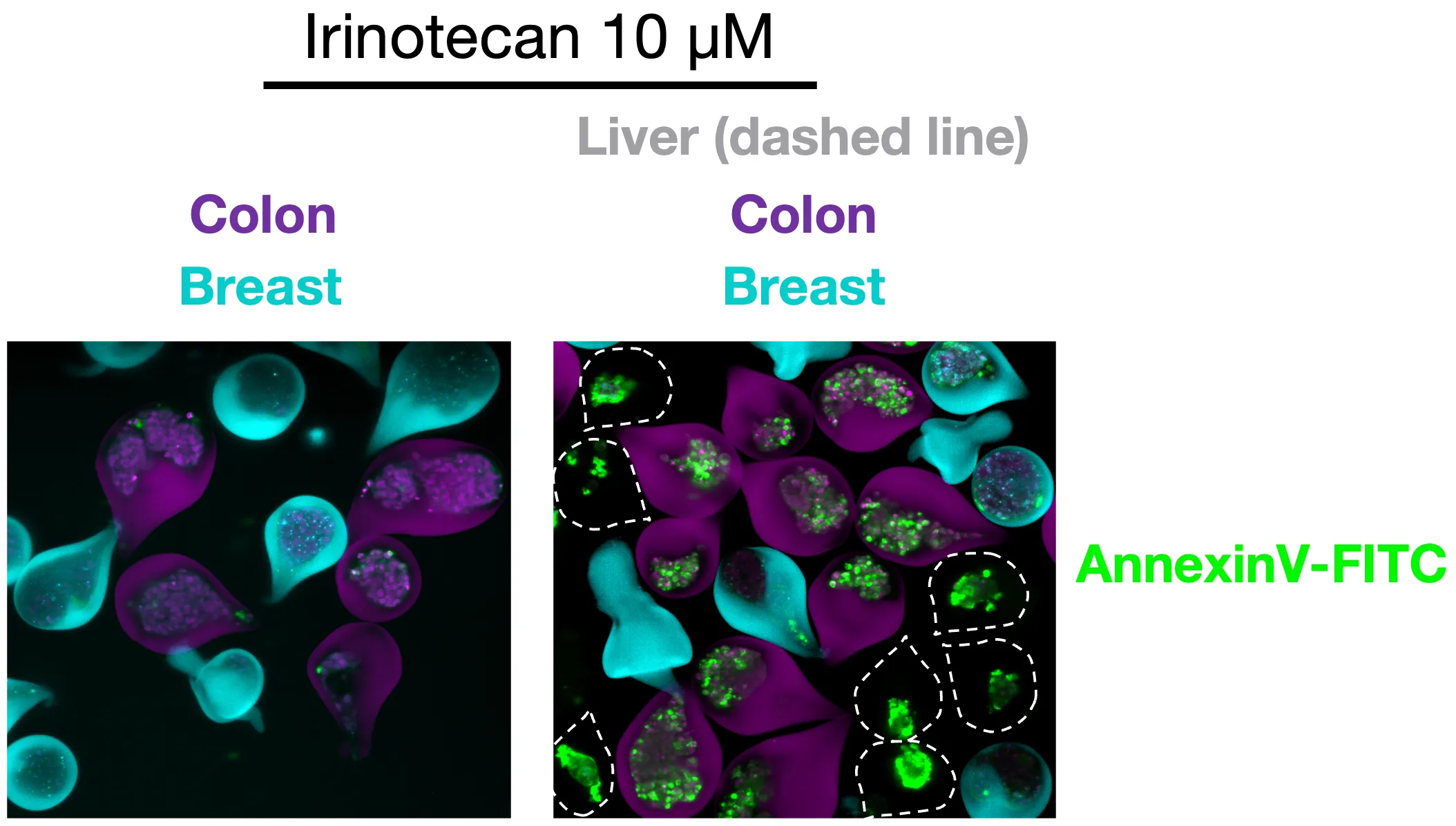
Confocal images with Colon/Breast cancer co-cultures with (left) or without Liver spheroids (right), treated 48h with Irinotecan 10µM. The induction of apoptosis was measured with an AnnexinV-FITC staining.
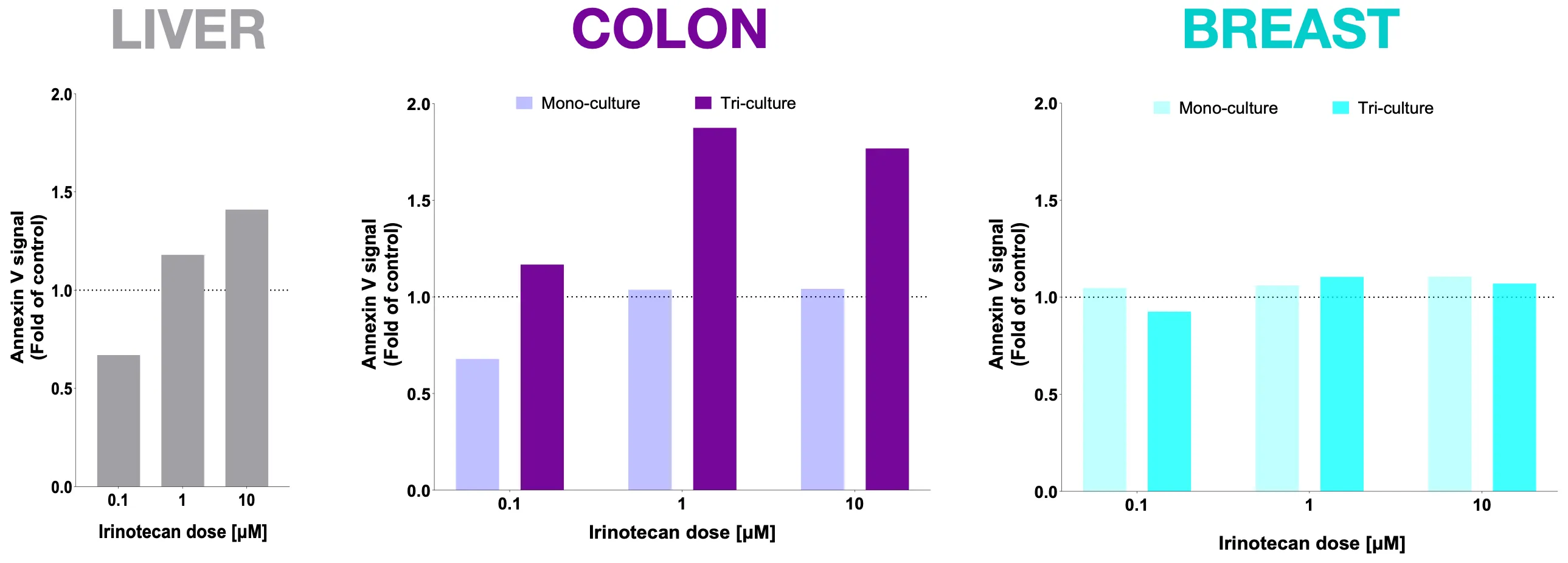
Cytotoxicity of increasing doses of Irinotecan on liver, colon, and breast cancer spheroids in mono- or tri-culture, quantified by measuring the AnnexinV signal expressed as fold of control.
key results
- Potentialization of the efficacy of Irinotecan (2-fold increase) on colon carcinoma spheroids by liver spheroids.
- Dose-dependent hepatotoxicity of Irinotecan.
- Selective efficacy: no effect on breast adenocarcinoma spheroids.
References
- Fuchs C, Mitchell EP, Hoff PM. Irinotecan in the treatment of colorectal cancer. Cancer Treatment Reviews, 32(7): 491-503 (2006).
- Mathijssen RHJ, van Alphen RJ, Verweij J, et al. Clinical Pharmacokinetics and Metabolism of Irinotecan (CPT-11). Clinical Cancer Research, 7(8): 2182–2194 (2001).
partnership models
Predictive biology
starts today