13.08.2026
Fluoscore
Oncology
Liver + Breast cancer
DMPK
Tamoxifen: Liver-dependent efficacy on breast adenocarcinoma
About the drug
Tamoxifen is the first endocrine therapy drug and one of the most prescribed to treat breast cancer since more than four decades. However, Tamoxifen was discovered fortuitously because it is inactive by itself. Indeed, it needs to be metabolized by the liver first to be active against breast tumors (Figure 1). The liver-dependent efficacy of Tamoxifen on breast adenocarcinoma has never been demonstrated in vitro because of the lack of systemic assay available.
Experimental design
To evaluate the liver-dependent efficacy of Tamoxifen, we designed a 2-tissue co-culture with encapsulated liver spheroids (HepaRG cell line) and encapsulated breast cancer spheroids (MCF-7 cell line) expressing a reporter gene to measure the activity of the estrogen receptor, the target of Tamoxifen. A dose-response with increasing doses of Tamoxifen was performed on the co-culture and on a mono-culture of encapsulated breast cancer spheroids and the estrogen response was measured after 48h of treatment. A mass spectrometry analysis was carried out in parallel to analyze the effective metabolization of Tamoxifen by liver spheroids.

Metabolization of Tamoxifen by the liver with the enzymes involved and the different metabolic byproducts.

Dose-response of Tamoxifen on the estrogen receptor activity in breast cancer spheroids co-cultured or not with liver spheroids.
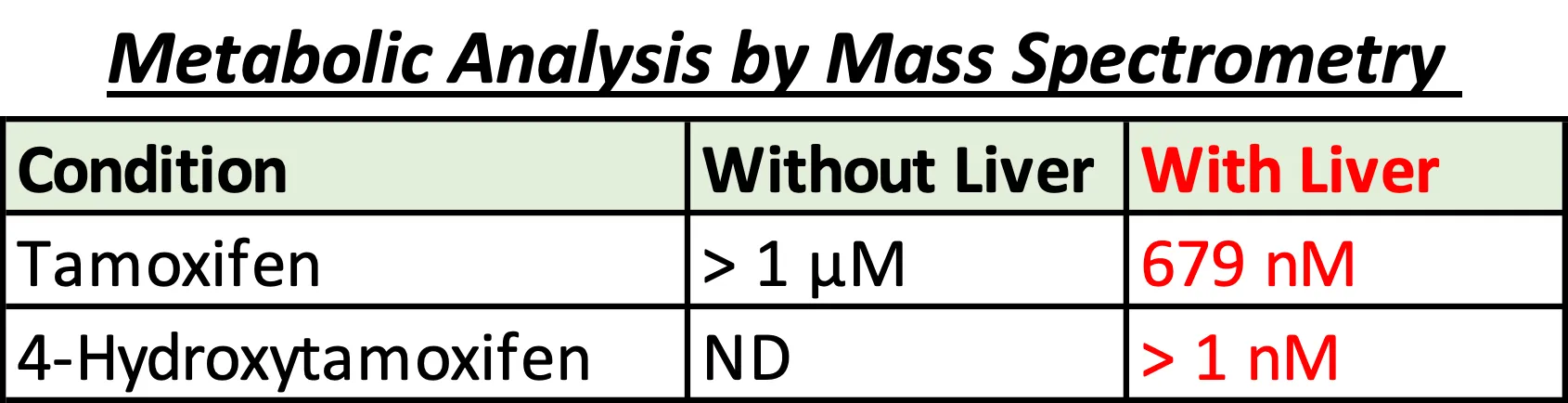
Mass spectrometry analysis of cell culture supernatants from liver spheroids treated with Tamoxifen
key results
- Strong activation (>5-fold) of the antiestrogen activity of Tamoxifen in breast cancer spheroids by liver spheroids (Figure 2).
- Metabolization of Tamoxifen into its active metabolite, 4-hydroxytamoxifen, by liver spheroids (Figure 3).
References
- V Craig Jordan. Tamoxifen: a most unlikely pioneering medicine. Nature Reviews Drug Discovery, 2: 205-213 (2003).
- Saladores P, Mürdter T, Eccles D.Tamoxifen metabolism predicts drug concentrations and outcome in premenopausal patients with early breast cancer. Pharmacogenomics Journal 15: 84–94 (2015).
- Dai X, Cheng H, Bai Z, Li J, et al. Breast Cancer Cell Line Classification and Its Relevance with Breast Tumor Subtyping. Journal of Cancer, 8(16): 3131-3141 (2017).
partnership models
Predictive biology
starts today